

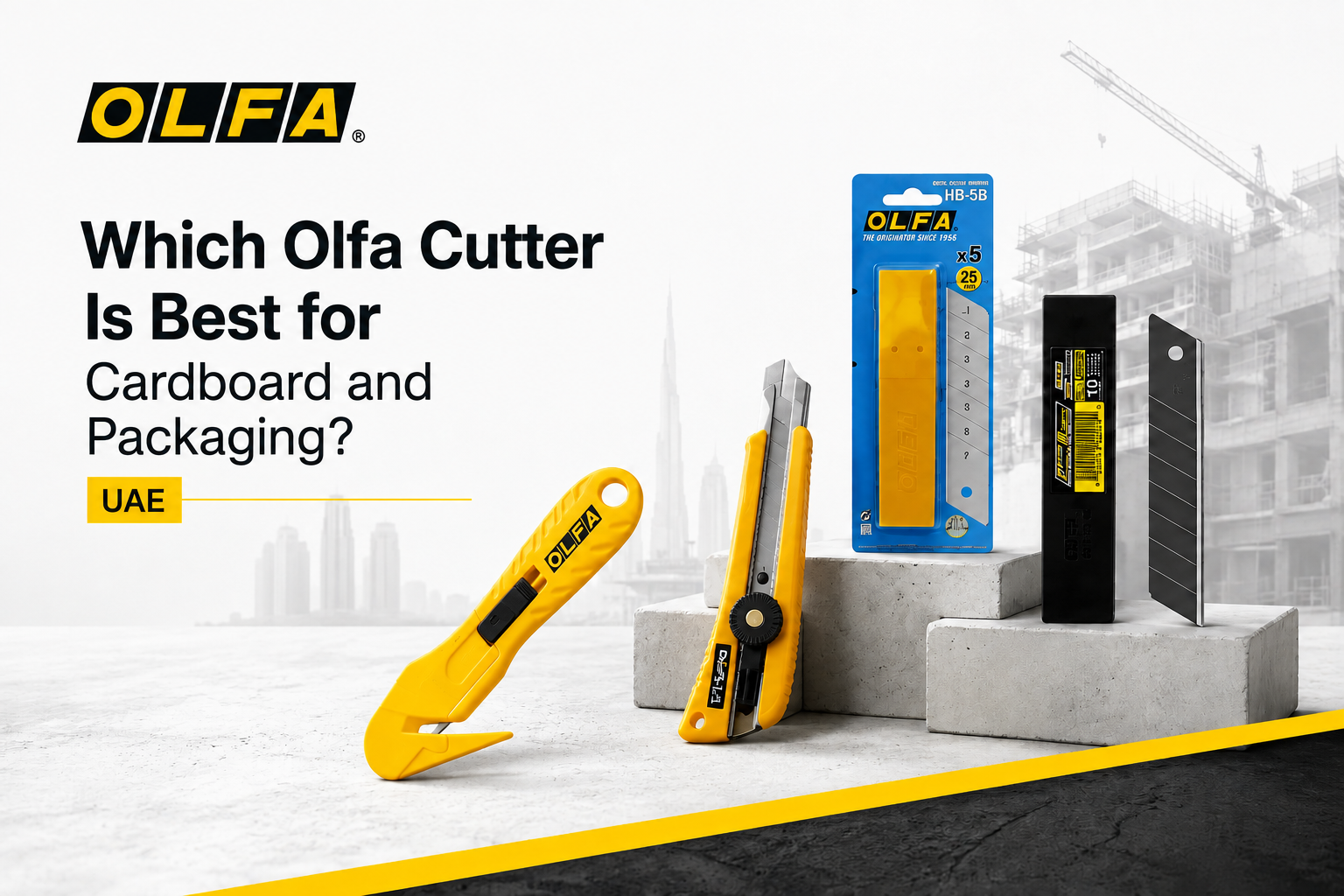
Anyone who breaks down boxes for a living, whether in a warehouse, a packaging facility, or a busy retail stockroom, knows that not all cutters handle cardboard the same way. A blade that seems fine for the first few boxes starts dragging and tearing by box fifty, and a poorly designed grip turns a simple task into hand strain by the end of a shift. Picking the right Olfa cutter for cardboard actually matters more than most people assume until they compare a good one against a worn-out box cutter from a junk drawer.
This guide breaks down the different Olfa cutter types suited to cardboard and packaging work, what separates a genuinely good packaging cutter from a mediocre one, and how to keep the whole process running safely across a full workday.
Need the right cutter for your operation? Browse Olfa cutters and blades at Koremax General Trading UAE or call +971 55 702 1234.
Why Cardboard Cutting Deserves More Thought Than It Gets
Cardboard seems like a simple material to cut, but corrugated board actually varies quite a bit in thickness and density, and repeated cutting dulls a blade faster than most people expect. A cutter that struggles with thicker double-wall boxes forces extra passes, which slows down high-volume packaging work and increases the chance of a slip.
This is exactly why choosing the right cardboard cutting knife matters for any operation handling boxes regularly, whether that’s a logistics warehouse processing hundreds of parcels a day or a retail stockroom breaking down deliveries each morning.
Understanding Olfa’s Cutter Categories
Olfa, the Japanese brand credited with inventing the snap-off blade utility knife back in 1956, produces several distinct categories of cutters, and knowing the difference helps match the right tool to the actual job rather than grabbing whatever is available.
Standard utility cutters are the general-purpose option most people picture when they think of a box cutter. These handle everyday cardboard cutting well, offering a reliable snap-off blade design that stays sharp through moderate daily use.
Heavy-duty cutters are built for tougher materials and higher volume work. These models handle thicker corrugated board, insulation, and other dense packaging materials with less drag than a standard blade, making them the better choice for construction sites or manufacturing environments where cutting demands go beyond typical office or retail packaging.
Safety cutters use a concealed or retractable blade design specifically to reduce the risk of accidental cuts. These are widely used in warehouses, retail stockrooms, and logistics operations where staff are opening dozens or hundreds of boxes throughout a shift, and injury prevention matters as much as cutting efficiency.
The Best Olfa Utility Knife Options for Different Cardboard Tasks
Matching the cutter to the actual task avoids both under-equipping a team with a blade that struggles, and over-equipping with heavier tools than the job actually needs.
For occasional to moderate cardboard cutting, a standard Olfa utility knife handles most single-wall and double-wall boxes without issue, and its snap-off blade design means a dull section can be broken off and replaced in seconds without needing a full blade swap.
For high-volume packaging and logistics environments, safety cutters with concealed blades are generally the better choice. Staff repeatedly opening boxes throughout a shift benefit far more from injury prevention than from raw cutting power, and these models are specifically designed for that kind of repetitive, high-frequency use.
For scoring, trimming, and general-purpose heavy use, Olfa’s LB-10 blades are a well-regarded option, offering a heavy-duty edge suited to general-purpose cutting, scoring, and trimming tasks that go beyond simple box breakdown, such as preparing custom packaging inserts or cutting through denser layered cardboard.
Cutting Cardboard Safely: What Actually Reduces Injury Risk
Even the best packaging cutter only performs as safely as the technique behind it. A few practices consistently reduce injury risk during repetitive cardboard cutting:
- Score before you cut through. For thicker cardboard, a shallow scoring pass followed by a second pass often works cleaner and safer than forcing a single deep cut.
- Always cut away from your body, keeping fingers and palms clear of the blade’s path at all times.
- Replace dull blades promptly. A dull blade requires more pressure to cut through material, which increases the chance of the blade slipping unpredictably.
- Use a cutter with a safety lock or blade guard when the tool isn’t actively in use, particularly in environments where multiple people share equipment.
- Choose a cutter with an anti-slip grip, especially relevant in packaging environments where hands may be gloved or slightly damp from handling materials.
Replacement Cutter Blades: Why the Snap-Off Design Matters
One of the practical advantages of Olfa’s design is how replacement cutter blades work. Rather than needing an entirely new tool once a blade dulls, most Olfa utility and heavy-duty cutters use a segmented, snap-off blade. Once the cutting edge becomes dull or difficult to use, the worn segment simply snaps off along a scored line, exposing a fresh edge underneath without needing tools or downtime.
This matters considerably for operations doing high-volume cardboard cutting, since a quick blade snap takes seconds compared to sourcing and swapping an entirely separate blade, keeping packaging lines and stockroom work moving without unnecessary interruption.
Watch for Counterfeit Products When Buying Online
The UAE cutting tools market, like many others, has seen counterfeit products circulating alongside genuine ones, and fake blades can compromise both performance and safety. Original Olfa packaging includes clear branding, product codes, and manufacturing details, and buying through an authorized supplier significantly reduces the risk of ending up with a substandard imitation that dulls faster or performs inconsistently compared to a genuine blade.
Why Koremax General Trading UAE Is a Reliable Source for Olfa Cutters in Dubai
We supplies authentic Olfa cutters and blades across Dubai, covering standard utility cutters, heavy-duty cutters, safety cutters with concealed blades, and a full range of replacement blades including the LB-10 heavy-duty line. As an established Olfa products supplier, Koremax General Trading UAE sources directly rather than through secondary resellers, which helps ensure every cutter sold matches Olfa’s original quality and safety standards rather than risking an unauthorized substitute.
Businesses across construction, packaging, and logistics sectors in Dubai rely on Koremax General Trading UAE specifically because the inventory covers the full range of Olfa’s cutting categories in one place, rather than needing to source standard, heavy-duty, and safety cutters from separate suppliers.
Frequently Asked Questions
What’s the difference between a standard Olfa utility knife and a heavy-duty cutter?
A standard utility knife handles everyday cardboard and packaging tasks well, while a heavy-duty cutter is built for thicker, denser materials and higher volume cutting, making it better suited to construction or manufacturing environments rather than occasional box breakdown.
Are safety cutters actually less effective at cutting cardboard than standard utility knives?
Not meaningfully. Safety cutters with concealed or retractable blades still cut cardboard efficiently, and the slight trade-off in raw exposed blade length is generally outweighed by the reduced injury risk in high-frequency cutting environments like warehouses.
How often should a cutter blade actually be replaced?
This depends on cutting volume, but as a general guide, if a blade requires noticeably more pressure to cut through the same material it handled easily before, it’s due for a snap-off or replacement rather than continuing to push through with a dulled edge.
Can the same cutter handle both cardboard and tougher materials like insulation or rubber?
Heavy-duty cutters, including models using LB-10 style blades, are generally capable of handling both cardboard and denser materials, while standard utility cutters are better reserved for cardboard and lighter packaging tasks specifically.
How can I tell if an Olfa cutter purchased online is genuine?
Genuine Olfa products carry clear branding, product codes, and manufacturing details on the packaging. Buying through an established, authorized supplier is the most reliable way to avoid counterfeit products that compromise safety and performance.
Does Koremax General Trading offer bulk supply for warehouses or packaging facilities?
Yes, We supplies both individual cutters and larger bulk orders suited to warehouses, packaging facilities, and logistics operations needing consistent, reliable cutting tools across an entire team.
Choose the Right Cutter for the Job
Picking between a standard utility knife, a heavy-duty cutter, or a safety cutter with a concealed blade comes down to matching the tool to actual cutting volume and material thickness, not just grabbing whatever is closest. Our company stocks the full range of genuine Olfa cutters and replacement blades needed to equip a cardboard or packaging operation properly.
Get in touch today:
📞 +971 55 702 1234 | +971 58 516 1964
📧 sales@kmgtuae.com
📍 Al Burj Street, Deira, Dubai